
Showing top 0 results 0 results found
Showing top 0 results 0 results found
How to Write Affiliate Reviews That Actually Earn — And Why Affiliate Marketing Is 100% Legit



Affiliate marketing is legitimate, it pays real money, and writing product reviews is one of the simplest ways to get started. You promote products you trust, add your affiliate links, and earn a commission when someone buys. No inventory, no customer support, no complicated setup.
The question most beginners actually have isn’t “what is affiliate marketing” — it’s “is this a scam, and can someone like me make real money from it?” The answer to both is clear: it’s legitimate, and yes, people earn real income from it every day. This guide explains how, with real earning numbers and a straightforward breakdown of how to write affiliate reviews that convert.
If you want a concrete way to get started, the Text Partner Program offers 20% recurring lifetime commissions, a 120-day cookie window, and products that businesses actively search for every day. You can join free before you even publish your first review — and your affiliate links will be ready the moment you do.
What you’ll learn:
What affiliate reviews are and why they work
Affiliate reviews are one of the easiest ways to earn online because they rely on something you already know how to do: share your opinion. When you write an affiliate review, you explain what a product does, what you liked, what you didn’t, and who it’s right for. If a reader decides to buy through your affiliate links, you earn a commission.
The idea behind affiliate marketing is straightforward. Companies want real people to talk about their products or services in real language. Instead of paying for ads that get ignored, they pay affiliate marketers for actual results. It’s a transparent system: you help someone make a decision, and the company pays you for bringing in that sale.
In practice, being an affiliate means you:
-
Join an affiliate program that gives you a unique tracking link
-
Use that link in reviews, tutorials, comparisons, or social media posts
-
Earn a commission when someone buys because of your content
You’re not handling customer questions, shipping orders, or anything complicated. You’re simply recommending products or services that make sense for your audience.
Here’s where affiliate reviews stand out: people trust them. When someone searches “Is this tool worth it?” or “Best software for small businesses,” they’re looking for honest experience — not a sales pitch from the company itself. If you can offer that clarity in a simple, friendly way, you’ll naturally build the kind of trust that leads to consistent affiliate income.
Affiliate reviews succeed because they’re genuinely useful. You’re giving people the information you wished you had before buying something yourself. That’s a legitimate way to earn online — and when you do it well, the commissions follow naturally.
Looking for a beneficial partnership?
Join our Affiliate Program to unlock a new revenue stream and stand out from the competition.
Is affiliate marketing legit — or is it a scam?
Affiliate marketing is 100% legit. It’s a real, widely used business model and one of the top ways to earn online — used by companies ranging from Amazon to Shopify to Salesforce because it’s an effective, measurable way to acquire new customers. You send a buyer to a company, they pay you a commission. That’s the whole model.
The reason many people question whether affiliate marketing is legitimate usually comes down to two things: they’ve seen exaggerated income claims online, or they’ve confused it with multi-level marketing or outright fraud. These are completely different things. Affiliate marketing has no recruitment requirement, no downline, no product you have to buy yourself, and no get rich overnight promises. You earn only when someone you refer makes a real purchase.
Is affiliate marketing a scam? The model itself is not. Like any industry, there are bad actors — affiliates who promote low-quality products or services, misrepresent what they earn, or use misleading content to drive clicks. That kind of approach damages trust and rarely leads to sustainable income. Legitimate affiliate marketers succeed by doing the opposite: recommending products or services they genuinely believe in, being transparent about their affiliate links, and putting their audience’s needs first.
Does affiliate marketing work? Yes — when the content is genuinely helpful and the products are worth recommending. Affiliates who write thin, generic reviews or promote tools they’ve never used tend to see poor conversion rates and give up early. Affiliates who publish honest, specific, experience-based content build trust with their audience over time — and that trust is what drives real, consistent sales.
Is affiliate marketing worth the time and effort? For the right person — someone willing to publish consistently and help readers make better decisions — it’s one of the best low-overhead online income models available. The main investment is time and effort. The barrier to entry is low. The upside, especially with recurring commission programs, is real.
How much do affiliate marketers make?
Affiliate marketing income varies widely, and anyone giving you a single definitive number is either oversimplifying or exaggerating. What’s more useful is understanding the range, what drives the differences, and what realistic milestones look like for new and experienced affiliate marketers alike.
Can you make $100 a day with affiliate marketing?
Yes, and many affiliate marketers reach this milestone earlier than they expect. A typical day at the $100 mark might look like:
-
Two small commissions from lower-priced products
-
One medium commission from a software subscription
-
Occasional spikes from comparison posts or “best tools for X” guides
You don’t need thousands of visitors to get there. You need the right traffic — people who are already close to a buying decision and just need a clear, honest recommendation to push them over the line. High-intent traffic with good conversion rates beats high-volume traffic with no buying intent every time.
How do affiliate marketers reach $10,000 a month?
This level of affiliate marketing income comes from building momentum over time. Affiliate marketers who reach $10,000/month consistently tend to do the same things:
-
Focus on recurring commission programs — SaaS software is the top category here
-
Target long-tail keywords like “best live chat tool for small businesses” rather than broad terms
-
Publish dozens of reviews and posts over time, not just a handful
-
Build an email list that drives traffic to new content on day one
-
Promote products and services that businesses keep subscribing to for years
Here’s why recurring commissions matter so much for long-term income: with tools like LiveChat or ChatBot, you earn a commission every month for as long as the customer stays subscribed. One good review, published once, can keep generating income for years without you touching it again. That’s what makes affiliate marketing income compound in a way that one-time commission programs never do.
What does affiliate marketing income actually look like month to month?
Most people earn their first commission within 2–4 months of publishing consistently. A rough income progression looks like this:
-
Months 1–3: $0–$50/month. Building content, learning what works, getting first clicks.
-
Months 4–6: $50–$300/month. First consistent commissions, content starting to rank.
-
Months 6–12: $300–$1,500/month. Compounding effect from multiple reviews ranking simultaneously.
-
Year 2+: $1,500–$10,000+/month. Strong content library, email list, and recurring commission base all working together.
These aren’t guarantees — they’re realistic benchmarks based on consistent publishing and smart program selection. The affiliate marketers who stall are usually the ones who publish a few reviews, see slow early results, and give up before the compounding effect kicks in. Success in affiliate marketing isn’t about one viral post. It’s about showing up consistently over time.
Looking for a beneficial partnership?
Join our Affiliate Program to unlock a new revenue stream and stand out from the competition.
What makes a helpful affiliate review
A great affiliate review doesn’t try to impress anyone. It helps the reader understand whether the product is right for them. Clarity beats polish every time.
-
Explain the product in everyday language. Skip the jargon. Focus on how the product actually feels to use. What grabbed your attention? What surprised you? What almost made you walk away?
-
Share real pros and cons. Not a wall of bullet points — just a few meaningful observations. A balanced review signals that you’re on the reader’s side, not the company’s. Readers can spot a fake con from a mile away (“the only downside is that it’s too good”). Give them the real trade-offs.
-
Show what you’re talking about, don’t just describe it. Screenshots, short video walkthroughs, or step-by-step descriptions of how you actually used the product make your review feel credible. Think about explaining it to a friend over coffee, not writing a product manual.
-
Answer the two questions everyone has. Who is this for? Who should skip it? These two questions alone can dramatically improve conversion, because readers want to quickly see whether they fit the user profile.
-
Keep the tone conversational. A good review sounds like a person talking, not a template filling itself in. Short paragraphs, contractions, natural sentence rhythm. If it reads stiff, read it aloud. That usually reveals where it stops sounding human.
-
Cut the fluff. Readers skim before they commit. Make it easy for them to find what matters. If a sentence doesn’t help them make a decision, remove it.
The reviews that convert are the ones written by someone who clearly used the product and cared about helping the reader get it right. That’s what builds a reputation as a reviewer worth trusting — and trust is what turns a blog post into consistent affiliate income.
How SEO drives traffic to your affiliate reviews
You can write the best review in the world and earn nothing from it if no one finds it. That’s where search engine optimization comes in — and for affiliate marketers, it’s one of the highest-leverage skills to develop early.
The basic idea is this: people search for specific things on Google every day, and your job is to create content that answers those searches. The more precisely your review matches what someone is already looking for, the more likely it is to show up in their search results and drive traffic to your affiliate link.
One of the most important lessons from experienced SEO practitioners is to stop chasing broad, competitive keywords and start targeting specific, long-tail ones. “Affiliate marketing” is nearly impossible to rank for. “Best affiliate programs for customer service tools” is genuinely winnable. The more specific the keyword, the less competition — and the more likely the person searching it is ready to make a decision.
A few things that matter most for getting your reviews found
Your title tag is the single most important SEO element on any page. It’s what Google reads first and what searchers see in results. Include the product name, a clear intent signal (like “review,” “vs,” or “honest look”), and ideally the year, since people want recent information.
Internal linking is consistently the most overlooked SEO move. When you write multiple reviews, link them. A review of LiveChat can link to your review of ChatBot. Google uses these links to understand which pages on your site are related and how important each one is. It also helps readers discover more of your content, which builds session depth and trust.
Write content that actually answers people’s questions completely. The search results for almost any product keyword show a “People Also Ask” section — a list of follow-up questions real users type into Google. If your review addresses five of those questions directly, it stands a much better chance of ranking and staying ranked.
And don’t underestimate freshness. Updating a review once a year (with new pricing, new features, or recent customer feedback) signals to Google that your content is maintained and current. That matters more than it used to.
The payoff for getting SEO right is that your reviews keep working while you’re not. A blog post that ranks for the right keyword earns commissions every month with no ongoing effort. That’s the real meaning of passive income in affiliate marketing.
Looking for a beneficial partnership?
Join our Affiliate Program to unlock a new revenue stream and stand out from the competition.
How to start affiliate marketing from zero
Starting with affiliate reviews is simpler than many people think. You don’t need a website, years of experience, or a large audience. You need a clear niche, a product or service worth recommending, and a space to share your thoughts.
1. Pick a niche you understand
Choose a topic you use, follow, or care about. It doesn’t need to be a passion — just a niche you can talk about naturally and consistently. The more familiar you are with the products or services in that space, the easier it is to write honest, specific reviews that your audience actually finds useful. A well-defined niche also makes it easier for the right traffic to find you.
2. Join reputable affiliate programs with strong commission structures
Look for programs with clear terms and conditions, good commission rates, and stable products. Software is the top starting point for new affiliate marketers because it pays recurring commissions — you keep earning as long as the customer stays subscribed, not just for the first sale. A strong program to join right away is the Text Partner Program: 20% recurring lifetime commission, 120-day cookie window, free to get started, and products that businesses actively search for and keep paying for long-term.
3. Create a space to promote products and publish your content
You only need one platform to become an affiliate. Options include:
-
A basic blog or review website
-
A YouTube channel
-
TikTok or Instagram
-
A niche newsletter
-
A Reddit or Quora presence
Pick the format that suits how you naturally communicate. If you’re a better writer, start with a blog. If you’re comfortable on camera, YouTube works faster for some niches. The right platform is the one you’ll actually use consistently.
4. Write honest, easy-to-read reviews
Your first reviews don’t need to be perfect. They need to be honest, specific, and genuinely helpful to your audience. Cover what the product does, who it’s good for, real pros and cons, and your actual experience using it. That’s more valuable than any amount of polished marketing language — and it’s what builds the trust that drives real conversion rates.
5. Add your affiliate links and disclose them clearly
A simple disclosure — “this article contains affiliate links; if you sign up, I may earn a commission at no extra cost to you” — is legally required in most jurisdictions, keeps you in line with affiliate program terms and conditions, and builds trust with your audience. Transparency is a conversion asset, not a liability. Readers who know you may earn a commission but trust your judgment are more likely to become real sales than readers who feel misled.
6. Promote your content where people are already searching
Once your review is live, promote it where your audience is: relevant communities, social media posts, short-form video, or answers on Quora. Basic SEO practices — keyword-focused titles, clear headings, descriptive meta descriptions — help your content get found in search results over time and bring in new traffic without ongoing effort.
How affiliates get paid
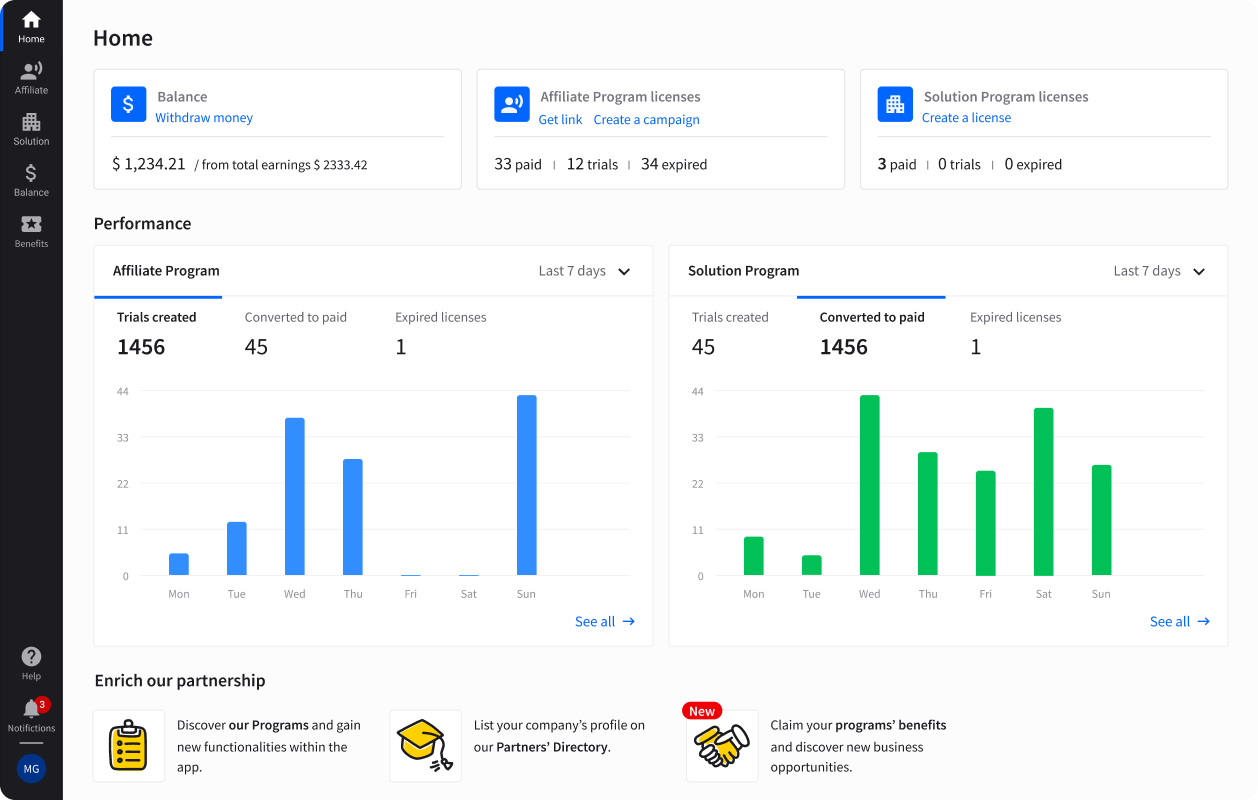
Most programs track clicks and purchases through your unique affiliate links and pay you monthly once you hit their minimum payment threshold. You can see everything in your account dashboard: clicks, trials, signups, commissions, and upcoming payouts. The Text Partner Program, for example, provides real-time tracking of all of these so you always know exactly where your income stands.
How to write a product review that converts
A great affiliate review doesn’t try to impress — it helps the reader decide. People click on reviews because they want clarity, not enthusiasm. Here’s how to write a product review that genuinely serves your audience and earns commissions naturally.
Step 1: Explain the product in everyday language
Skip the jargon. Describe what the product does the same way you’d explain it to someone new to the industry over coffee. Focus on how it actually feels to use — what got your attention, what surprised you, what almost made you look for a different tool. Real language builds real trust.
Step 2: Share specific, honest pros and cons
A few meaningful observations beat a list of twenty bullet points. Include real drawbacks — a steep learning curve, a pricing tier that seems overpriced, a feature that’s missing. Honest pros and cons make your review believable and signal to your audience that you’re on their side, not the company’s. This is one of the clearest ways to distinguish legitimate affiliate content from promotional fluff.
Step 3: Show, don’t just tell
Screenshots, short video clips, or step-by-step descriptions of how you used the product go a long way toward building trust. Real examples are more convincing than abstract praise. Describe a specific moment — “When I first set up the chatbot, it took about 20 minutes and I didn’t need to read the docs” — and readers can picture themselves doing the same. Multimedia elements like these also improve time on page, which supports SEO.
Step 4: Answer the two questions every reader has
No matter how long your review is, make sure it clearly answers:
-
Who is this product right for?
-
Who is it not right for?
This section alone can significantly improve conversion rates because people want to quickly see whether they fit the user profile. Be direct. “This tool is ideal for small business owners managing customer support solo. It’s probably overkill if you have fewer than 20 customer conversations a week.” Clear, specific guidance like this is what turns a browser into a buyer.
Step 5: Keep a conversational tone throughout
A good affiliate review reads like you’re talking to someone, not filing a report. Short paragraphs, contractions, and plain language keep your audience engaged and make your opinion feel like a real recommendation rather than a scripted sales page. New affiliate marketers often over-formalize their writing — the ones who earn trust write the way they talk.
Step 6: End with a clear, specific CTA
Don’t end with “I hope this review helped.” End with a direct recommendation: who should buy this product, why, and a link to get started. “If you’re running a customer support team and need a live chat solution that scales, LiveChat is worth the free trial. You can get started here.” One specific, well-placed affiliate link at the end of a thorough review will outperform five generic links scattered throughout.
The best recurring affiliate programs for review-focused content
One of the top decisions you’ll make as an affiliate is whether to focus on one-time or recurring commission programs. One-time commissions pay a flat fee per sale. Recurring commissions pay every month the customer stays subscribed — which means one good review keeps generating income without you touching it again.
For context: a 20% recurring commission on a $49/month product pays you $9.80 every single month that customer remains subscribed. Refer 10 customers and that’s $98/month — from a single review, compounding as long as those customers stay. That’s what makes recurring programs the top choice for affiliate marketers building long-term income.
Here are the strongest recurring affiliate programs for content creators and reviewers:
Text Partner Program — 20% recurring lifetime commission (rising to 22% after 5 referrals), 120-day cookie, two-tier system that pays 5% on sales made by affiliates you refer. Products include LiveChat, ChatBot, and HelpDesk — tools businesses actively search for, use daily, and retain long-term. Free to join, no minimum traffic, and the affiliate account dashboard offers real-time visibility into all your earnings. The top all-around recurring program for SaaS review content.
HubSpot — 30% recurring commission, capped at 12 months. Strong brand recognition makes it a good program to promote in marketing niches, but the 12-month cap limits long-term compounding compared to lifetime programs.
Pipedrive — 20% recurring commission, also capped at 12 months. Good fit for sales-focused content. Easier to promote than enterprise CRM alternatives and well-known enough that your audience will likely recognize the name.
Semrush — $200 flat per sale rather than recurring. High per-sale payment makes it attractive for high-traffic sites, but there’s no ongoing income from retained customers — one sale, one payment.
Freshworks — 15% recurring commission, capped at 12 months. Broad product suite covering CRM, customer support, and IT tools. A useful program to join if your content covers multiple business software categories.
The pattern worth noting: most competing programs cap their recurring commissions at 12 months. The Text Partner Program doesn’t — which is why it offers better long-term income even against programs with higher headline commission rates. For affiliate marketers focused on building passive income over time, lifetime recurring beats short-term recurring every time.
Can you do affiliate marketing without a website?
Yes — you don’t need a website to become an affiliate or to start earning real commissions. A website is a useful asset once you’re publishing consistently and want to build traffic from search engines, but many affiliate marketers earn significant income without one, especially when they’re new to the industry.
Platforms that work well for affiliate reviews without a website:
YouTube — Video reviews are among the most trusted content formats for people researching products before buying. YouTube is the second-largest search engine in the world, which means well-optimized video reviews can rank and drive affiliate clicks for years. Include your affiliate links in the video description with a clear disclosure and a direct prompt to look below for the link.
TikTok and Instagram Reels — Short-form video works especially well for demonstrating software tools in action. A 60-second walkthrough showing a product’s top feature and linking to a full review in your bio can drive real traffic even with a small following. Many new affiliate marketers see their first sales come from these platforms before they’ve built any SEO traffic.
Newsletter or email list — A niche newsletter is one of the top conversion-friendly formats for affiliate reviews because subscribers have actively opted in to receive your recommendations. Affiliate links in email tend to convert at higher rates than search traffic because the audience already trusts you enough to give you access to their inbox.
Quora and Reddit — Long-form answers on Quora and genuine contributions in relevant subreddits can drive targeted traffic to your affiliate links without any website at all. These platforms require real helpfulness — overtly promotional posts get removed and damage your account — but a well-written answer that recommends a product and explains why can bring in readers for months.
LinkedIn — For SaaS and B2B products specifically, LinkedIn is an underused affiliate channel. A detailed post reviewing a business tool, written in a clear and professional tone, can reach a highly qualified audience of decision-makers who are actively looking for the kind of tools you promote.
A website becomes valuable when you want to build an SEO-driven content library that compounds over time and brings in traffic without ongoing promotion. But if you’re new and want to get started today, pick the platform where you’re most comfortable and use that to publish your first review. The goal is to start, not to have everything right from day one.
Looking for a beneficial partnership?
Join our Affiliate Program to unlock a new revenue stream and stand out from the competition.
Conclusion
Affiliate marketing is legit, it works, and writing honest product reviews is one of the most accessible ways to earn online. You don’t need a large audience, a polished website, or years of industry experience. You need clarity, consistency, and products worth recommending to the right people.
The affiliate marketers who build real, lasting income do one thing consistently: they put the reader’s decision first. A review that genuinely helps someone choose the right product earns more trust — and drives more sales — than any amount of persuasive language or aggressive promotion. That’s the whole business model, and it’s a good one.
If you’re looking for a clear way to get started, the Text Partner Program offers 20% recurring lifetime commissions on products businesses actively rely on. Join free, set up your affiliate account, get your links, and publish your first review. Each one you publish becomes a permanent asset — bringing in new traffic, earning commissions, and compounding over time.
Join the Text Partner Program** — free, 2 minutes. Start earning recurring commissions from your first review.**
FAQ
Is affiliate marketing legit?
Yes. Affiliate marketing is a legitimate, mainstream business model used by companies ranging from Amazon and Shopify to niche SaaS startups. It’s not a scam and it’s not a get rich quick scheme — it’s commission-based referral marketing that’s been a standard part of online business for over 25 years. Companies pay affiliate marketers because it’s an effective, measurable way to get new customers. You send a buyer, they pay you a commission. There’s no fraud, no recruitment requirement, and no product you have to purchase yourself to participate.
Does affiliate marketing work?
It works when the content is genuinely helpful and the products or services are worth recommending. Affiliate marketers who write thin, generic reviews or promote tools they’ve never used tend to see poor conversion rates and give up early. Those who publish honest, specific, experience-based content build real trust with their audience over time — and that trust is what drives consistent sales. The model works. The time and effort you put into high-quality content is what separates those who earn from those who don’t.
How much do affiliate marketers make?
The range is genuinely wide. New affiliate marketers typically earn their first commission within 2–4 months of publishing consistently, starting at $0–$50/month. With consistent content and smart program selection — especially recurring commission programs — $300–$1,500/month is realistic within 6–12 months. Full-time affiliate marketers running established content sites often earn $3,000–$10,000+/month. The top income driver isn’t raw traffic volume — it’s recurring commissions from retained SaaS customers, which compound month over month without additional work.
How do affiliates get paid?
Each affiliate program gives you a unique set of affiliate links. When someone clicks your link and makes a purchase, the sale is recorded in your account dashboard. Most programs pay monthly once you reach their minimum payment threshold — typically $50–$100. Payment methods vary by program but usually include bank transfer, PayPal, or check. The Text Partner Program pays monthly with full real-time visibility into clicks, trials, signups, and upcoming earnings so you always know exactly what to expect.
What does it mean to be an affiliate?
It means you promote products or services, share your honest experience with them, and earn a commission when your recommendation leads to a sale. You’re not an employee of the company, you don’t handle any part of the transaction, and you have no obligation to promote products you don’t believe in. You’re an independent content creator who earns income based on the real results you drive — one of the clearest examples of performance-based online business.
How can I start affiliate marketing as a beginner?
Pick a niche you understand, join a few reputable programs with strong commission structures and clear terms and conditions, and publish honest reviews on a platform where your audience already searches for information. You don’t need a website, a large following, or significant upfront investment. The Text Partner Program is a strong program to join for anyone covering SaaS, productivity, or business tools — it’s free to get started, beginner-friendly, and pays recurring commissions from your very first referral.
Can you make $100 a day with affiliate marketing?
Yes, and it’s a milestone many affiliate marketers reach faster than they expect. Getting there typically requires a handful of published reviews targeting products with real search demand, combined with at least one recurring commission program so earlier referrals continue to pay while you build new content. The path to $100/day isn’t one viral post — it’s a small library of helpful reviews where several pieces of content are each contributing a few commissions per month. Good conversion rates on targeted traffic matter far more than raw visitor numbers.
How can someone realistically make $10,000 a month with affiliate reviews?
By promoting high-demand products, targeting search-friendly topics, publishing consistently over 12–24 months, building an email list that drives traffic to new content, and focusing on recurring commission programs so income builds on itself month over month. The affiliate marketers who reach this level aren’t doing anything exotic — they’ve built a content library where many reviews are each generating a few hundred dollars a month in recurring commissions simultaneously. Join the right programs, promote the right products, put in real time and effort, and the numbers become very achievable over time.
What is an example of an affiliate?
A blogger who reviews project management software and earns a monthly commission every time a reader signs up through their affiliate links. A YouTuber who compares live chat tools and links to them in the video description. A newsletter writer who recommends a CRM to their audience and gets paid for every trial that converts to a real sale. All of these people are affiliate marketers — they create helpful content, promote products or services they believe in, and earn commissions based on the results they drive.


